3.25. Permissions
In pgModeler, permissions generate the GRANT and REVOKE commands for the associated objects. Unlike all the other editing forms designed to handle one instance of an object, the permission editing form handles all permissions for a particular database object.
In PostgreSQL, permissions are composed of one or more roles and a set of privileges applied to the associated object. Only a few kinds of database objects can have permissions assigned to them, namely: database, tables, columns, views, sequences, functions, aggregates, languages, domains, types, schemas, tablespaces, foreign data wrappers, foreign servers, foreign tables, and procedures. The attributes of the permissions form are detailed below.
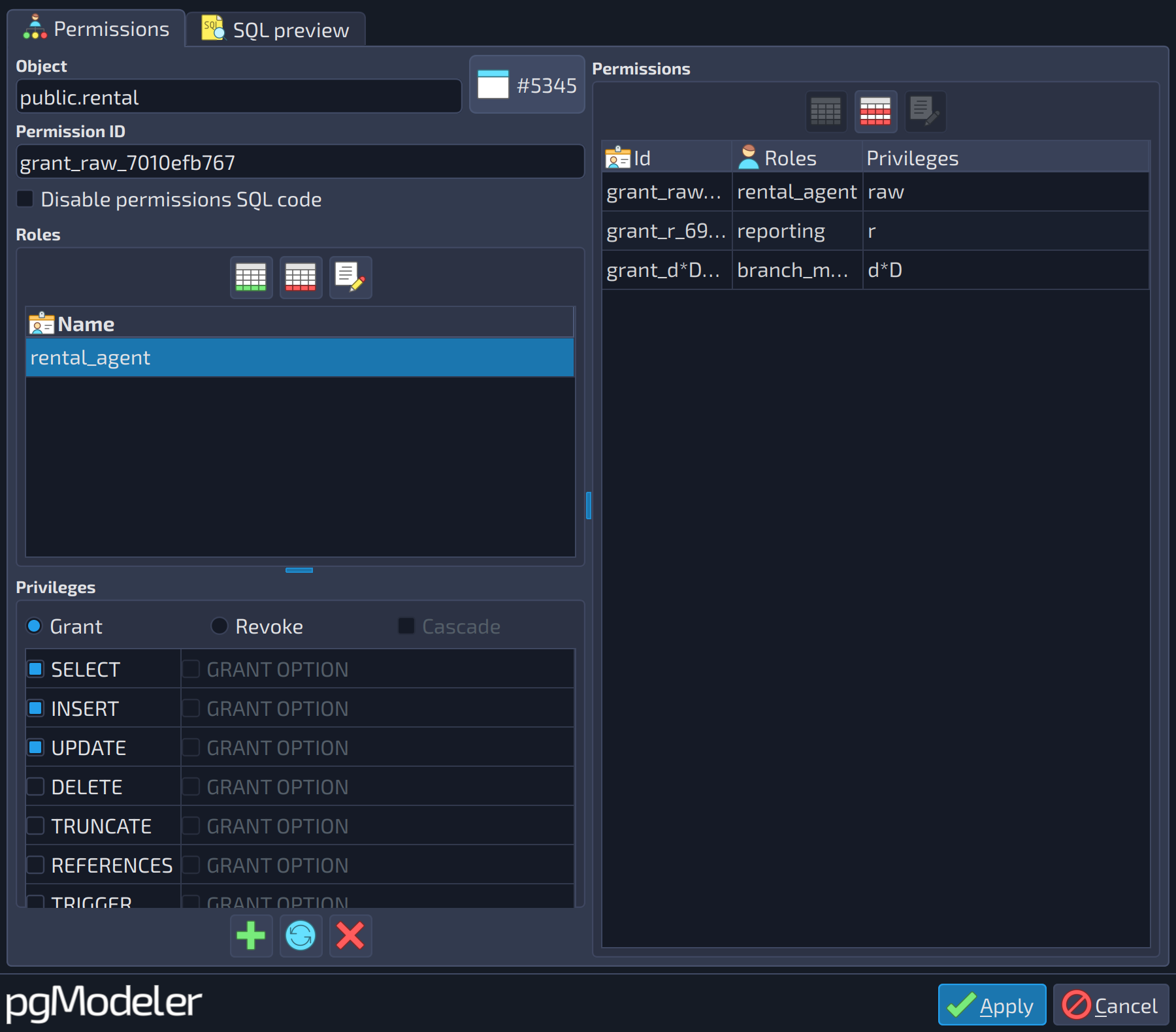 12345678910111213141516171819202122232425
| Permissions | |||
|---|---|---|---|
| # | Field | Group box | Description |
| 1 | Object | The signature of the object that receives the permissions. It can't be changed. | |
| 2 | Permission ID | The unique identifier of the permission being edited. It can't be changed by the user. | |
| 3 | Permissions | All the permissions configured for the object. Use this list to select, edit, or delete one or all of them. | |
| 4 | Disable permissions SQL code | Disables the SQL code ( | |
| 5 | Roles | The roles that receive the privileges checked in the group | |
| 6 | Grant | Privileges | Creates a |
| 7 | Revoke | Privileges | Creates a |
| 8 | Cascade | Privileges | This option is used only for revokes (it is enabled when |
| 9 | SELECT | Privileges | Includes the privilege |
| 10 | GRANT OPTION (SELECT) | Privileges | Allows the roles to grant the privilege |
| 11 | INSERT | Privileges | Includes the privilege |
| 12 | GRANT OPTION (INSERT) | Privileges | Allows the roles to grant the privilege |
| 13 | UPDATE | Privileges | Includes the privilege |
| 14 | GRANT OPTION (UPDATE) | Privileges | Allows the roles to grant the privilege |
| 15 | DELETE | Privileges | Includes the privilege |
| 16 | GRANT OPTION (DELETE) | Privileges | Allows the roles to grant the privilege |
| 17 | TRUNCATE | Privileges | Includes the privilege |
| 18 | GRANT OPTION (TRUNCATE) | Privileges | Allows the roles to grant the privilege |
| 19 | REFERENCES | Privileges | Includes the privilege |
| 20 | GRANT OPTION (REFERENCES) | Privileges | Allows the roles to grant the privilege |
| 21 | TRIGGER | Privileges | Includes the privilege |
| 22 | GRANT OPTION (TRIGGER) | Privileges | Allows the roles to grant the privilege |
| 23 | Add Permission | Adds a permission with the roles and privileges currently configured. | |
| 24 | Update Permission | Updates the permission selected in the list with the current roles and privileges. | |
| 25 | Cancel Operation | Cancels the editing of the selected permission and clears the form. | |
References
Permission DDLs
https://www.postgresql.org/docs/current/static/sql-grant.html
https://www.postgresql.org/docs/current/static/sql-revoke.html