3.4. Indexes
Indexes are applied to a set of columns and are primarily used to enhance database performance. This kind of object is composed of basic attributes and a set of elements with their own attributes, which define the index as a whole. In the database model, pgModeler includes indexes at the bottom of tables in a portion called the extended attributes section. The image below shows an example of how an index is displayed in a table.
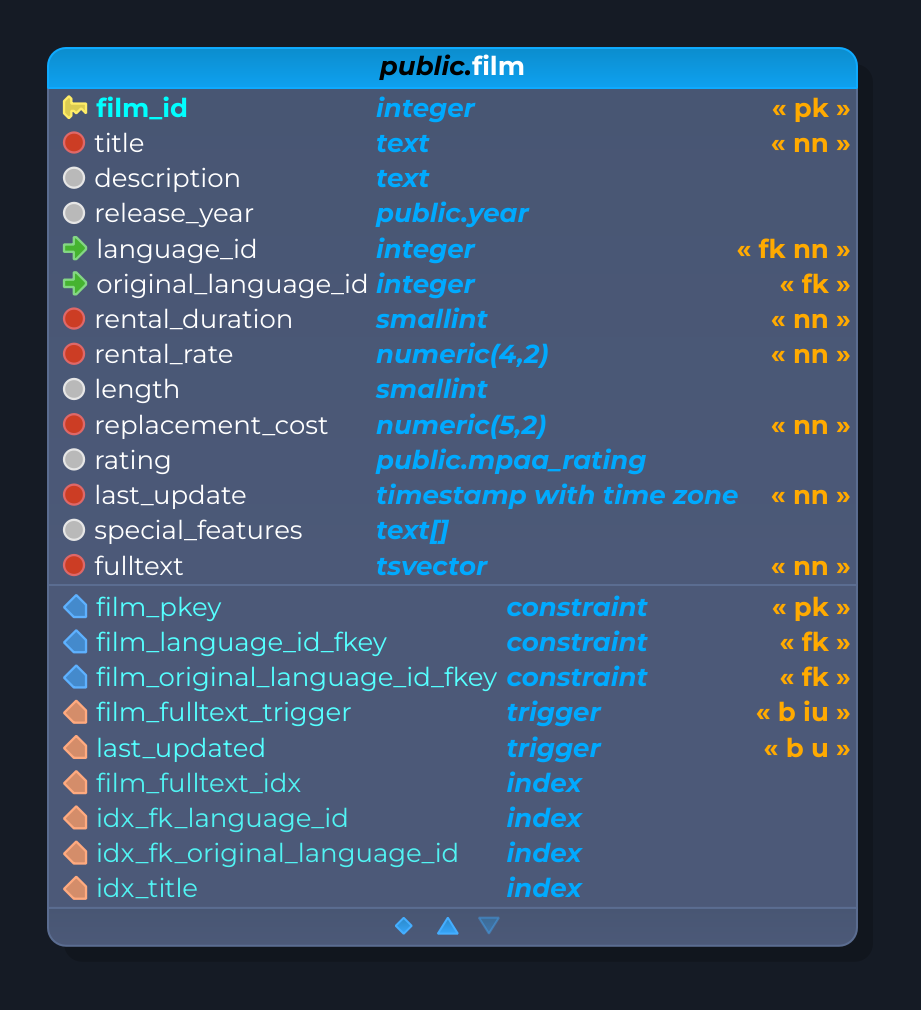
Index attributes
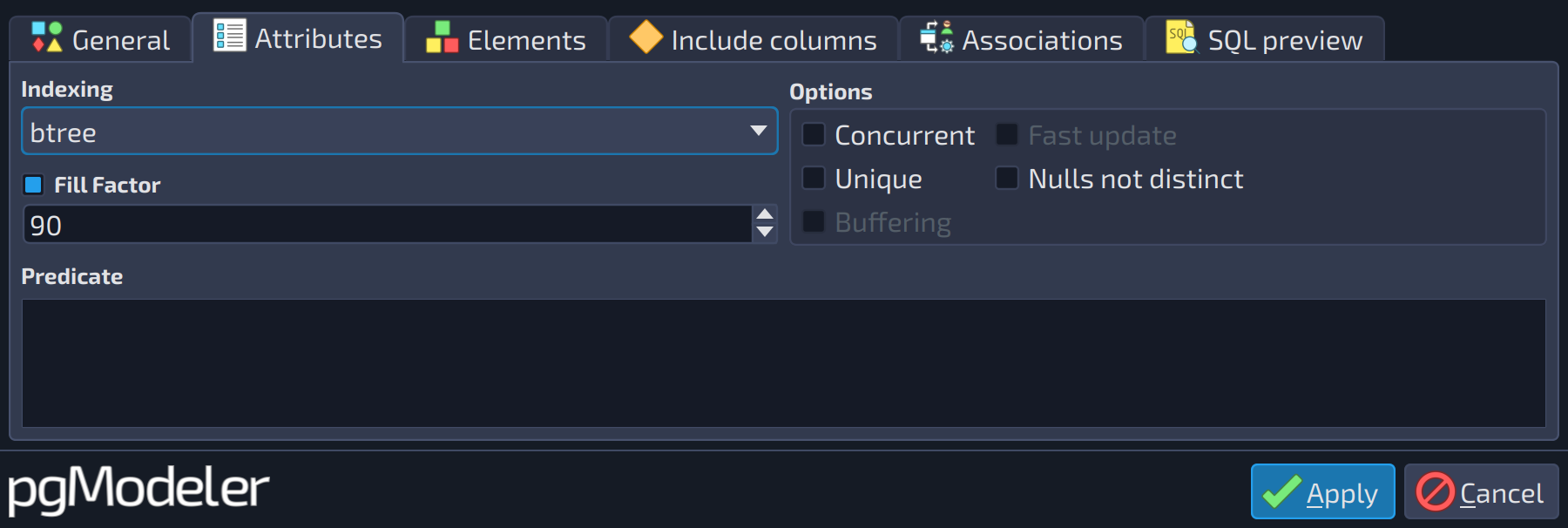
Basic attributes of the index, like indexing mode (also called access method), fill factor, predicate, and others, are configured in the tab Attributes in the index editing form. Their meaning and accepted values are detailed in the table below.
 123456789
| Attributes | |||
|---|---|---|---|
| # | Field | Group box | Description |
| 1 | Indexing | Index access method to be used. Possible values are | |
| 2 | Concurrent | Options | Creates the index without any locks that prevent concurrent insertion, deletion, or updates on the table. |
| 3 | Fast update | Options | Enables fast update techniques for GIN indexes. |
| 4 | Fill Factor | This attribute is related to how much (in a percentage from 10 to 100) the index pages are packed (in terms of physical space usage). This means that if your table is intended to have lots of updates, you should use a small fill factor; on the other hand, static tables or the least updated ones can use a greater fill factor to save disk space. Details about the fill factor attribute can be found in the PostgreSQL documentation. | |
| 5 | Unique | Options | Indicates that duplicate values must be checked when the index is created on the table (if data already exists) and each time data is added. In this case, errors will be raised when inserts or updates would cause data duplication. |
| 6 | Nulls not distinct | Options | Available from PostgreSQL 15. Applies to unique indexes: |
| 7 | Fill factor value | The fill factor percentage (from 10 to 100). It is enabled when the check box | |
| 8 | Buffering | Options | Enables the buffering technique for GIST indexes. |
| 9 | Predicate | The constraint expression for a partial index. | |
Index elements
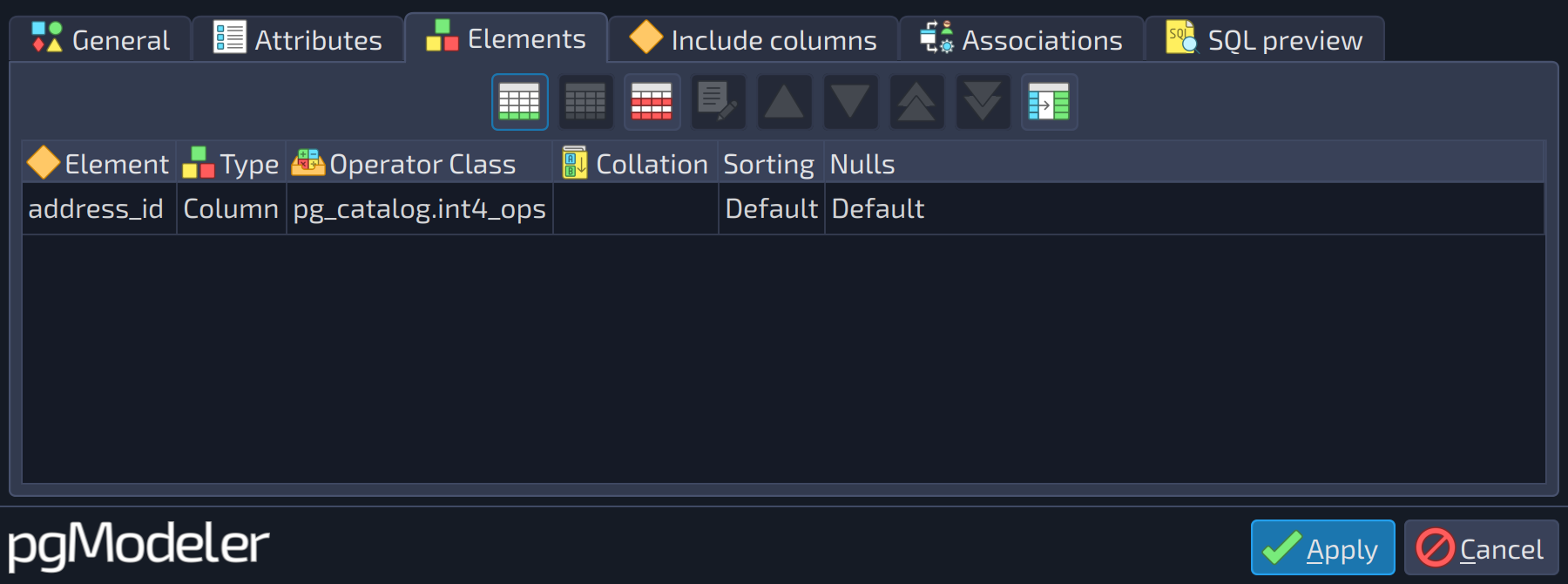
Index elements can be configured using a table column that will receive the index or a SQL expression. When all index elements are configured they will form the DDL command to create the index in the database. Their attributes are described in the following table.
 1
1
| Elements | ||
|---|---|---|
| # | Field | Description |
| 1 | Index elements | The elements of the index, each one a table column or a SQL expression with its operator class, collation, sorting, and nulls ordering. Each element is configured in the form described below. |
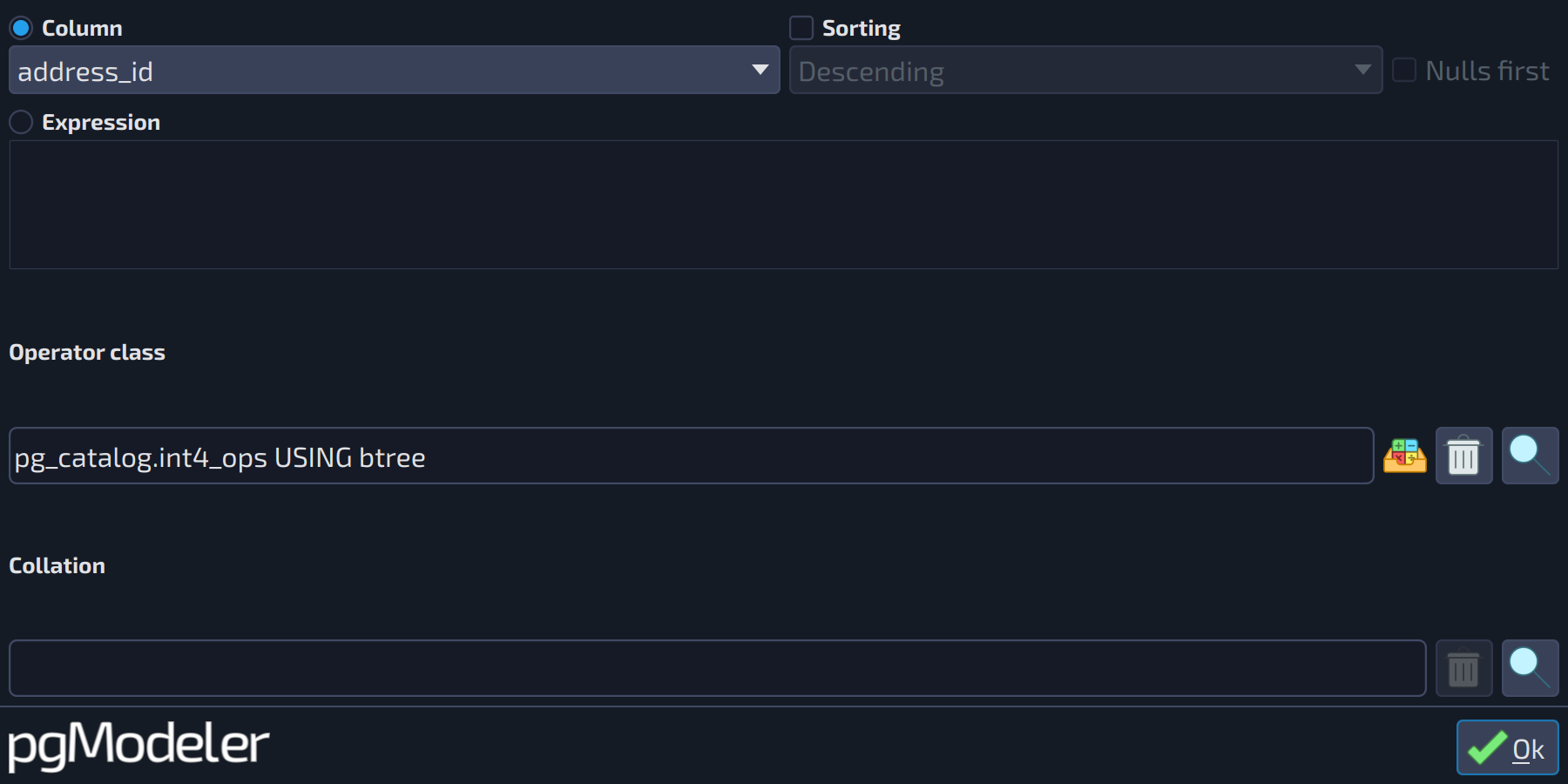
Each element is configured in the following form:
 123456789
| Index element | ||
|---|---|---|
| # | Field | Description |
| 1 | Column | Column that composes the current index element. This attribute is mutually exclusive with |
| 2 | Sorting | Enables the ordering option in the index element. |
| 3 | Element column | The column used as the element, when the option |
| 4 | Sorting direction | The sorting direction, ascending or descending, used when the check box |
| 5 | Nulls first | Indicates that null values must be ordered before non-nulls. |
| 6 | Expression | SQL expression that composes the current index element. This attribute is mutually exclusive with |
| 7 | Element expression | The SQL expression used as the element, when the option |
| 8 | Operator class | Operator class associated with the index element. |
| 9 | Collation | Collation associated with the index element. |
Non-key columns
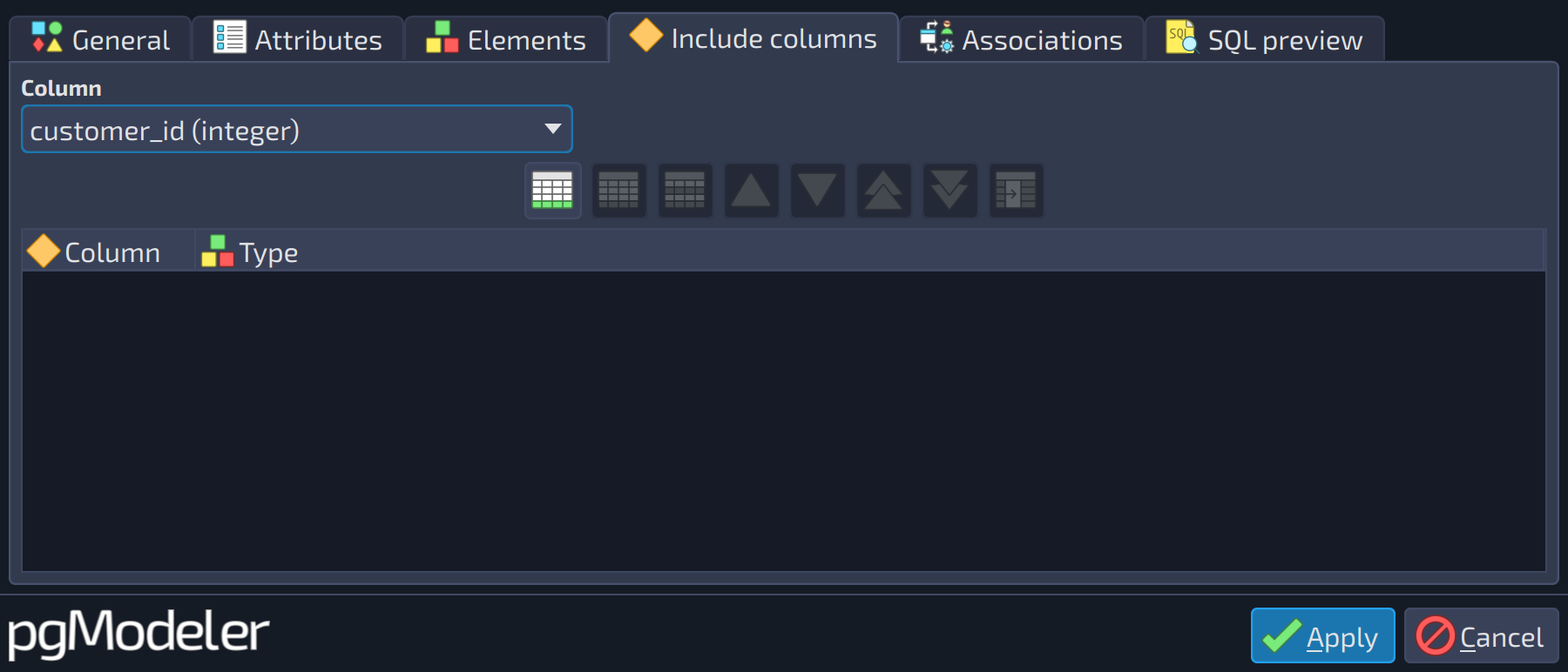
Non-key columns can be used to make effective use of index-only scans by choosing to create a covering index, which is an index specifically designed to include the columns needed by a particular type of query that is run frequently. Since queries typically need to retrieve more columns than just the ones they search on, PostgreSQL allows one to create an index in which some columns are just "payload" and are not part of the search key. This is done by adding an INCLUDE clause listing the extra columns. In pgModeler, this can be achieved by using the tab Include columns on the index form, as shown below.
 12
12
| Include columns | ||
|---|---|---|
| # | Field | Description |
| 1 | Column | List of columns owned by the table or view that can be used as non-key columns. |
| 2 | Non-key columns | The columns configured as non-key columns of the index ( |
References
Index DDL
https://postgresql.org/docs/current/static/sql-createindex.html
Index only scan & Covering indexes
https://www.postgresql.org/docs/current/indexes-index-only-scans.html