4.3. Relationships settings
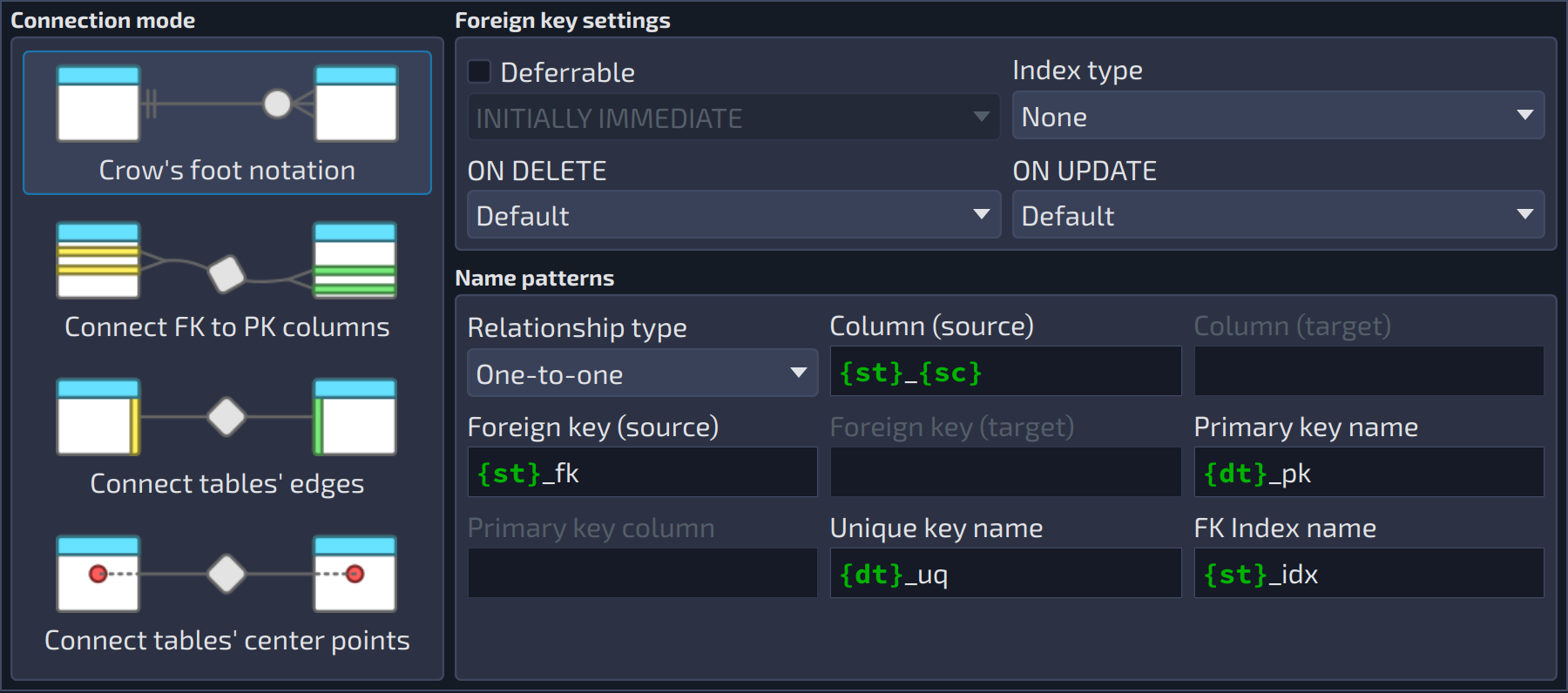
The purpose of the Relationships section is to define global properties when creating relationships in the database model. The settings handled here vary from the mode in which relationship lines are drawn to the patterns used to generate the names of columns and constraints created by the relationships when connecting them to tables. Relationship settings are organized into three groups, Connection mode, Foreign key settings and Name patterns, and they are detailed right below.
Connection mode
 1234
1234
| Connection mode | ||
|---|---|---|
| # | Field | Description |
| 1 | Crow's foot notation | This mode renders the relationships in crow's foot notation, which has better semantics and readability. It also determines the optimal point where the relationship is connected on the edges of the tables, taking their positions into account. |
| 2 | Connect FK to PK columns | This mode is available only for one-to-one, one-to-many, and fk relationships, but provides better semantics when linking tables by placing the lines on the exact point where the relationship occurs. It implies the usage of the classical ER notation. With this mode, the foreign key columns of the receiver table are directly connected to the primary key columns of the reference table, which helps to quickly identify the columns that represent the relationship. |
| 3 | Connect tables' edges | This mode determines the optimal point where the relationship is connected on the edges of the tables, taking their positions into account. It implies the usage of the classical ER notation. |
| 4 | Connect tables' center points | This mode is the classical one. It connects the relationship to tables through their central points. It implies the usage of the classical ER notation. This mode makes the columns that determine the relationship more difficult to identify visually, and its use is discouraged. This mode is the default for many-to-many, copy, and generalization relationships and can't be changed for them. draft |
FK settings & Patterns
This group of fields controls the settings for any foreign key generated by the relationships (deferral modes, update/delete modes). Also, in this group, the user can find the Index type (access mode) that is used to create an index on the relationship's generated foreign key columns. By default, all these attributes are used when creating new relationships, but they can be overridden by unchecking the Use global settings option in the relationship editing form.
This group of fields controls the name patterns for any object generated by relationships. These settings can also be overridden when creating new relationships by unchecking the Use global settings option in the relationship editing form.
1234567891011121314
| Foreign key settings | ||
|---|---|---|
| # | Field | Description |
| 1 | Deferrable | Makes the foreign keys generated by the relationships deferrable. These settings are used by the relationships that have the option |
| 2 | Deferrable | Deferral mode of the generated foreign keys: |
| 3 | Index type | Index access method used to create an index on the columns of the generated foreign keys. |
| 4 | ON DELETE | Action applied to the referencing rows when a referenced row is deleted ( |
| 5 | ON UPDATE | Action applied to the referencing rows when a referenced row is updated ( |
| Name patterns | ||
|---|---|---|
| # | Field | Description |
| 6 | Relationship type | Relationship type whose name patterns are being edited. Each type keeps its own set of patterns. |
| 7 | Column (source) | Pattern for columns generated based upon reference table's pk (1-1 and 1-n) or based upon source table's pk (n-n). |
| 8 | Column (target) | Pattern for columns generated based upon target table's pk (n-n). |
| 9 | Foreign key (source) | Pattern for foreign key generated based upon reference table's pk (1-1 and 1-n) or based upon source table's pk (n-n). |
| 10 | Foreign key (target) | Pattern for foreign key generated based upon target table's pk (n-n). |
| 11 | Primary key name | Pattern for primary key generated by identifier relationship. |
| 12 | Primary key column | Pattern for primary key generated by identifier relationship. |
| 13 | Unique key name | Pattern for unique key generated by the relationship. |
| 14 | FK Index name | Pattern for foreign key indexes generated by the relationship. |